


Since independence in 1968, the Health portfolio has changed its name and its remit several times, but its mission has remained constant: to protect the health of the whole population, in the Insular Region and in the Continental Region.
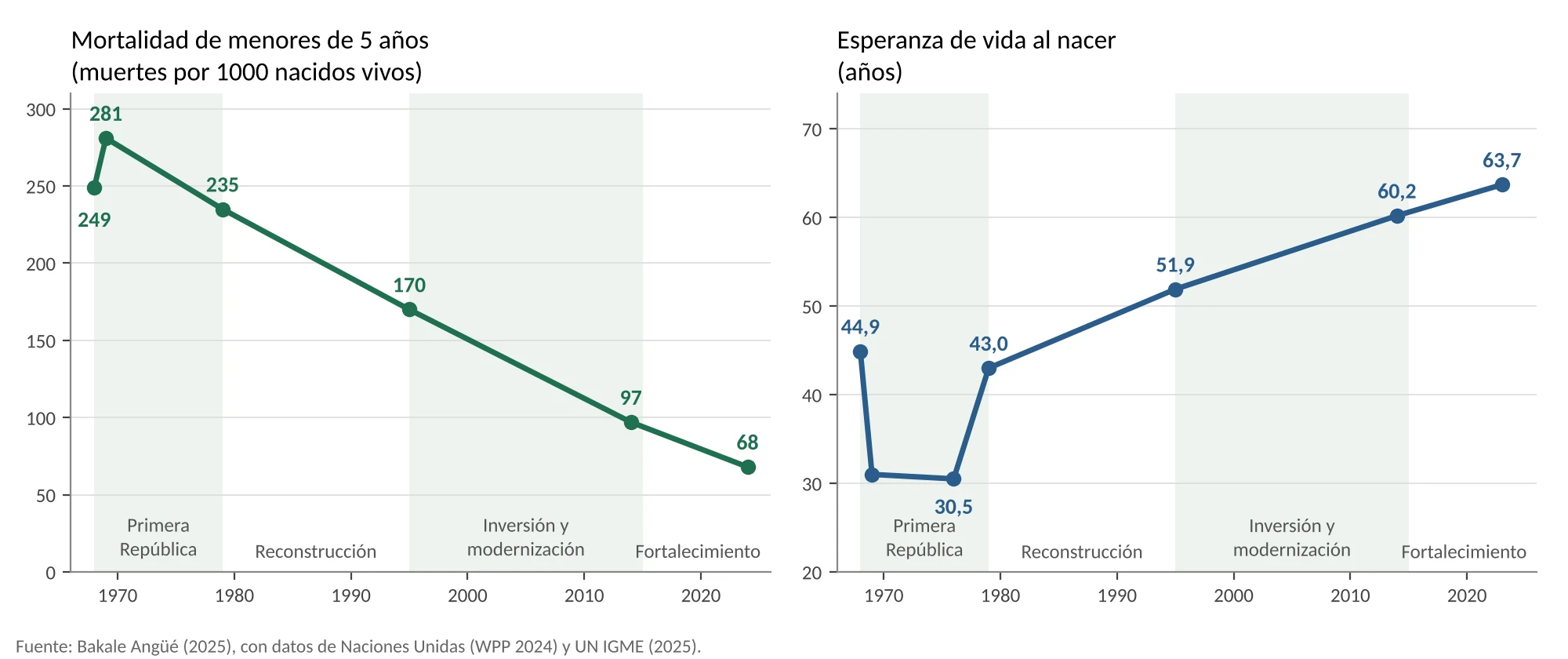
The results of that effort are measured in lives. In 1968, one child in four died before the age of five (249 per 1,000 live births) and life expectancy at birth was 44.9 years. In 2024 under-five mortality stands at 68 per 1,000 and life expectancy reaches 63.7 years (2023): of every thousand children born today, 181 more than in 1968 live to see their fifth birthday (Bakale Angüé, 2025, with United Nations data).
Seen across generations, a child born in 1979 had a 77 % chance of reaching age five; their children, born in the 1990s, 83 %; their grandchildren, born in the 2010s, 93 % (Bakale Angüé, 2025).
11827–1959
Background and colonial health care
The documented history of medical care in the territory begins in the 19th century. Before European administrations arrived, local communities, in particular the Bubi people of Bioko, had their own knowledge and practices for caring for the sick.
The British presence on Fernando Póo (1827–1843)
In 1827 the United Kingdom established Port Clarence, today's Malabo, as a base for its operations against the transatlantic slave trade. The arrival of sailors, traders, officials and people freed from slave ships made the treatment of fevers and other infectious diseases a necessity for the settlement.
The first Spanish health structures (1843–1869)
Spain had obtained its rights over Fernando Póo and Annobón through the treaties of 1777–1778 with Portugal, but effective occupation came later: the expedition of Juan José de Lerena (1843) consolidated the Spanish presence, reaffirmed by Nicolás Manterola in 1845.
The great step came in 1858. The expedition of Carlos Chacón, the first effective governor, left Cádiz on 19 April with medicines and materials to build a 40-bed wooden hospital, and with the Navy doctor José Pérez Lora in charge of health matters. Santa Isabel Hospital opened on 19 December 1858, days after the colony's first Organic Statute was approved (13 December), which provided for staff of the Military Health Corps for the garrison and for the population (De Granda Orive, Sanidad Militar, 2011).
In January 1859 the Military Health section was organised: two medical assistants, a pharmacist and two practitioners, with surgical instruments and a dispensary authorised to supply medicines to the inhabitants. During that decade the service faced the yellow fever epidemic of 1862, which led to stricter health inspections of ships; in 1863 it opened the Santa Cecilia convalescent station in Basilé, taking advantage of the altitude; and in 1864 it responded to a smallpox epidemic with vaccination and dedicated care for hundreds of patients (De Granda Orive, 2011).
In 1869, when the Organic Statute of November 1868 came into force, Military Health gave way to the first civilian health service: a physician-surgeon, two medical and surgical practitioners, a pharmacist and a pharmacy practitioner (De Granda Orive, 2011).
Tropical medicine takes shape (1870–1928)
At the end of the 19th century malaria was the predominant disease, as Luis López Saccone documented in his 1893 doctoral thesis, Apuntes médico-geográficos sobre la isla de Fernando Póo. In 1909 the Alfonso XIII National Institute of Hygiene sent an expedition, promoted by Santiago Ramón y Cajal and led by Gustavo Pittaluga, which described sleeping sickness foci in San Carlos, Concepción and Cabo San Juan: it was the first Spanish research in tropical medicine (Revista de Neurología).
Following those studies, blood tests were introduced for arriving workers, the island was divided into health zones with staff and diagnostic equipment, and the Bata hospital and the Kogo health post were enlarged. In 1927 the hypnosery for treating sleeping sickness opened in Santa Isabel, run from 1928 by the physician Luis Nájera Angulo (Nájera Morrondo, 2019).
The Health Directorate and the colonial network (1929–1959)
On 14 September 1929 the Health Directorate was inaugurated, based in Santa Isabel, with its own laboratory and a deputy directorate in Bata, and the San Carlos and Bata hospitals were rebuilt and enlarged. In the Continental Region, sleeping sickness services opened in Elobey, along with the Kogo hospital and health stations in Baho, Toplapla, Ensork and Alem (Nájera Morrondo, 2019).
The middle decades of the century consolidated a network of hospitals, dispensaries and medical posts, supported by the religious congregations, which provided much of the nursing staff, and by services of the agricultural estates (Bakale Angüé, 2025). The fight against leprosy was organised around the Mikomeseng leprosarium and the Ebebiyín camp, reference centres in the 1940s and 1950s (Brydan, 2018). From the late 1940s, the first Guineans began training in university-level health professions (Nsé Angüe, 2022).
21959–1968
Provinces, autonomy and the first Health Council
In 1959 the territories of the Gulf of Guinea were organised as two Spanish provinces, Fernando Póo and Río Muni. Under the autonomous regime, health passed for the first time into the hands of a Guinean official. Law 191/1963 of 20 December, on the Bases of the autonomous regime of Equatorial Guinea, created a Governing Council with eight councillors elected by the General Assembly (BOE, 30 December 1963).
Autonomy was approved in the referendum of 15 December 1963 and came into force on 1 January 1964, with Bonifacio Ondó Edú as president of the Governing Council (Autonomy referendum). With it, the highest health authority was no longer the governor-general but the Health councillor (Estudios Africanos, UAM).
Throughout the period the head of that Council was Gustavo de la Concepción Watson Bueco, councillor for Health and Welfare (Autonomy referendum). He took part in the 1966 debates at the United Nations (Reparación Africana) and in the Guinean delegation to the Madrid Constitutional Conference of 1967–1968 (Constitutional Conference).
In those years the Santa Isabel, Bata and San Carlos hospitals were fully operational, and in 1965 a new one was being built in Ebebiyín (Spanish Guinea).
The 1963 network and health investment. In 1963 the network included the Santa Isabel and San Carlos hospitals on the island and, on the mainland, those of Bata, Puerto Iradier (Kogo), Micomeseng, Sevilla de Niefang, Río Benito, Evinayong, Acurenam, Nsok, Ebebiyín, Valladolid de los Bimbiles and Mongomo de Guadalupe (Pélissier, 1964). In 1967 public health investment reached 76 million pesetas (Alogo Oyana, 2024).
Training professionals. In the mid-1960s the National School of Health Auxiliaries was created (Nsé Angüe, 2022), and the Santa Isabel Nursing School trained Guinean nurses: at the end of 1966 Santa Isabel hospital had 96 nurses and 3 midwives (United Nations, A/6700/Add.6, 1967). In 1963 there were two Guinean doctors and five practitioners (Nsé Angüe, 2022, citing Jones Sánchez).
Pioneers of health care in Equatorial Guinea
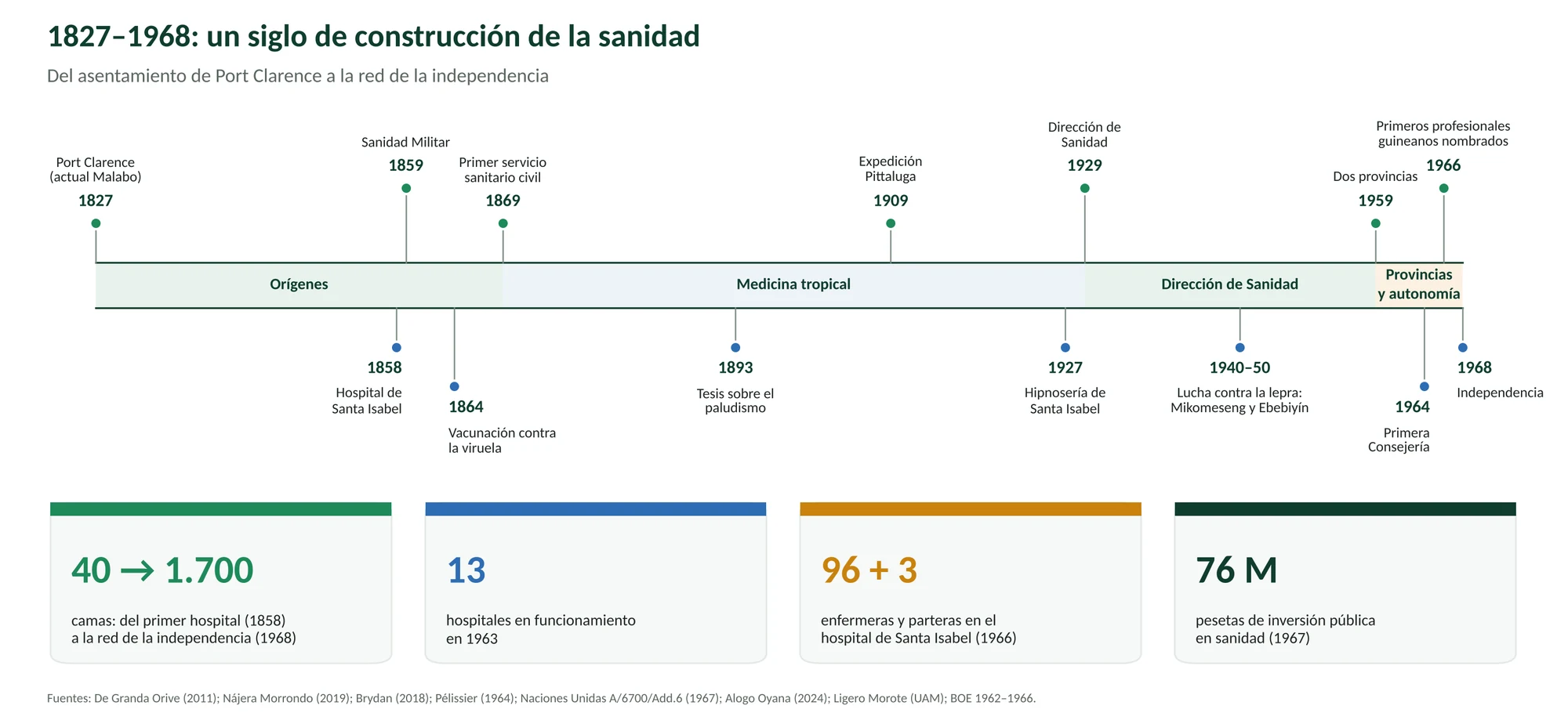
The official appointments published between 1962 and 1966 identify the first generation of Guinean health professionals: doctors, practitioners, health technicians and midwives who kept care going through the transition to independence. Their biographies are being reconstructed from archives and testimonies.
1964
Elías Manuel Maho Sicacha
Doctor of the Health Service
Practised as a doctor of the Health Service in 1964. Several sources name him as the first Guinean doctor.
1961–1968
Gustavo de la Concepción Watson Bueco
Second-class doctor of the Health Service
Commander of the Order of Africa (1961); first councillor for Health and Welfare of the autonomous Government (1964–1968).
1966
Damián Roku-Epitie Monanga
Graduate in Medicine and Surgery; second-class doctor of the Health Service
Appointed by Order of 8 September 1966. Bata Regional Hospital bears his name.
1962
Frida Ayana Krohnert Esono
Qualified practitioner of the Health Service
Granted the higher salary grade in 1962; one of the first documented women health professionals.
1966
Mariana Dougan Kake
Midwife of the Health Service
Appointed by Order of 20 August 1966; also listed in the 1969 staff list (as Dougan Rake).
1966
María Luisa Gorbeña Bondjale
Midwife of the Health Service
Appointed by Order of 20 August 1966; listed in the 1969 staff list.
1966
Victorina Koka Metete
Health technician; second-class practitioner
Appointed by Order of 22 November 1966.
1966
Deogracias Pearse Ikuga
Health technician; second-class practitioner
Appointed by Order of 22 November 1966.
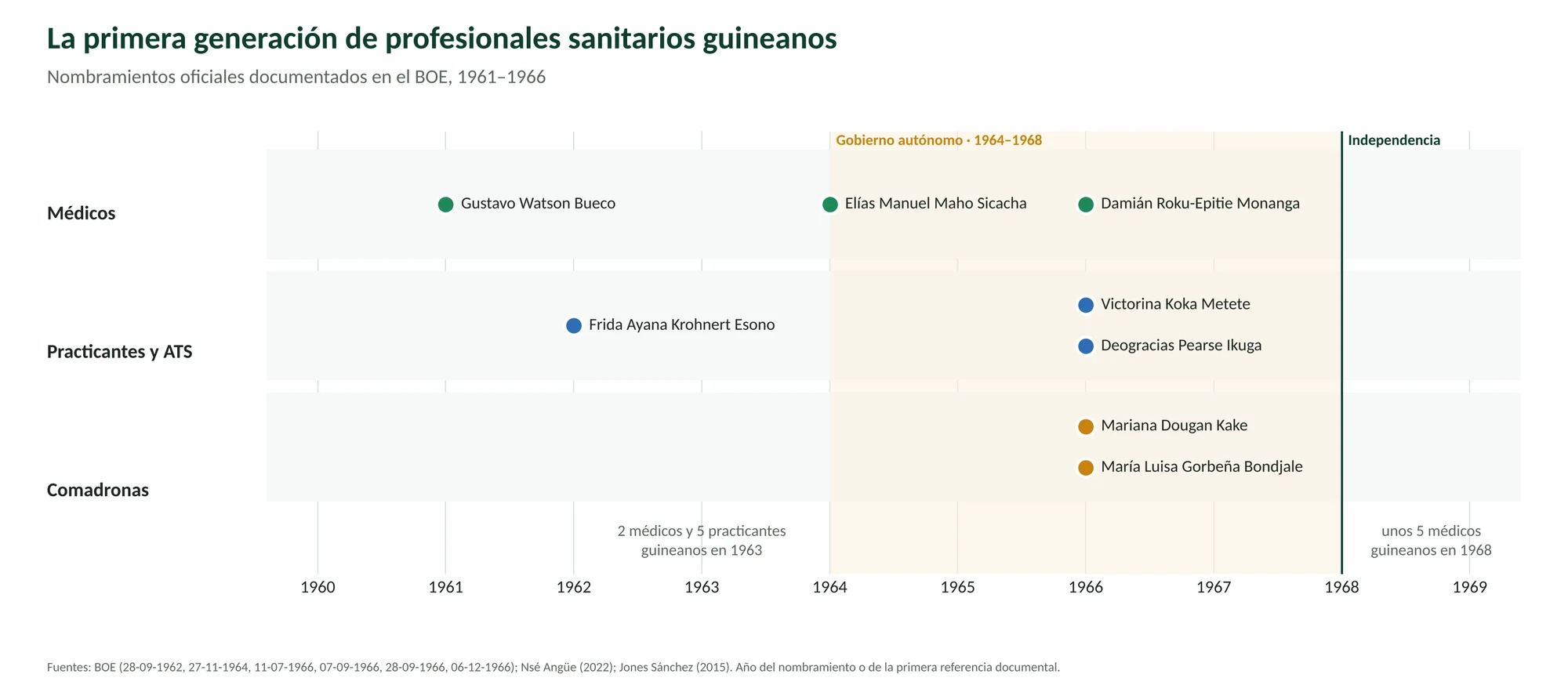
The 1968 indicators mark the starting point of the national system: life expectancy of 44.9 years and under-five mortality of 249 per 1,000. The network was concentrated on Bioko; in the Continental Region, larger and more populated, most people lived in villages far from the hospitals (Bakale Angüé, 2025).
31968–1979
Independence and the First Republic
With independence on 12 October 1968, the Ministry of Health of the Republic was born. Its first minister was Pedro Ekong Andeme, a native of Bata (CPDS). Rafael Obiang Nsogo later held the portfolio for two periods, 1969–1971 and 1976–1978 (Rulers.org).
In 1971 the first medical team from the People's Republic of China arrived, sent by the Health Department of Canton (Guangzhou). Since then Chinese medical cooperation has been continuous: in 2016 the country received the 28th team, assigned to Bata General Hospital and Malabo Regional Hospital (AidData).
The departure within a few months of the foreign technical staff and, later, of the religious congregations left hospitals and dispensaries with very few doctors and short of medicines (Bakale Angüé, 2025). The political crisis of those eleven years left the country exhausted and with barely a trace of the colonial health system, according to Jones Sánchez's study of health cooperation (Revista de Antropología Social, UCM, 2016).
Life expectancy fell as low as 30.5 years in 1976. In 1979 under-five mortality was 235 per 1,000 and life expectancy 43.0 years: that is the level from which the later reconstruction is measured (Bakale Angüé, 2025, with United Nations data).
41979–1995
Reconstruction and primary health care
After 3 August 1979, the Supreme Military Council formed its first cabinet on 23 August and entrusted the Health portfolio to Pablo Obama Eyang (Supreme Military Council).
Spanish Technical Cooperation began in 1979, in response to the new Government's urgent appeal (Spanish Technical Cooperation report). Spain sent a contingent of doctors and some 40 nuns from 14 congregations. Between 1980 and 1993 that cooperation sustained much of the sector and led the rehabilitation of the hospitals (Jones Sánchez, UCM). Its framework was the Treaty of Friendship and Cooperation signed on 23 October 1980 (Supreme Military Council), which opened a health partnership sustained for decades, together with the World Health Organization, UNICEF and other partners.
Basic care reopened quickly. With Spanish cooperation, the return of Guinean doctors trained in exile and the return of international organisations, the Malabo and Bata hospitals resumed their activity and rural health posts gradually reopened. Public health programmes that follow standard protocols (vaccination, oral rehydration salts, malaria control and maternal and child health) advanced especially fast (Bakale Angüé, 2025).
The country then adopted its own first health legislation:
1981
Decree-Law 3/1981 of 25 September, on the Bases of Health, placed the State's health services under the Ministry of Health and created the National Health Council (FAO-LEAP), as well as the National School of Health and the Central Public Health Laboratory. The health professions were also regulated in these years (Official Gazette of Equatorial Guinea, FAOLEX).
1985
Law 4/1985 of 24 October created the National Traditional Medicine Service (FAO-LEAP). That year Primary Health Care became the pillar of the sector (CRC 1342, University of Bremen).
1990
A Presidential Decree created the district health management structures (CRC 1342).
1992–1994
Spanish aid began to be channelled through NGOs and the Federation of Religious Health Workers; in 1994 Spain halved its aid and withdrew some 25 doctors (Jones Sánchez, UCM).
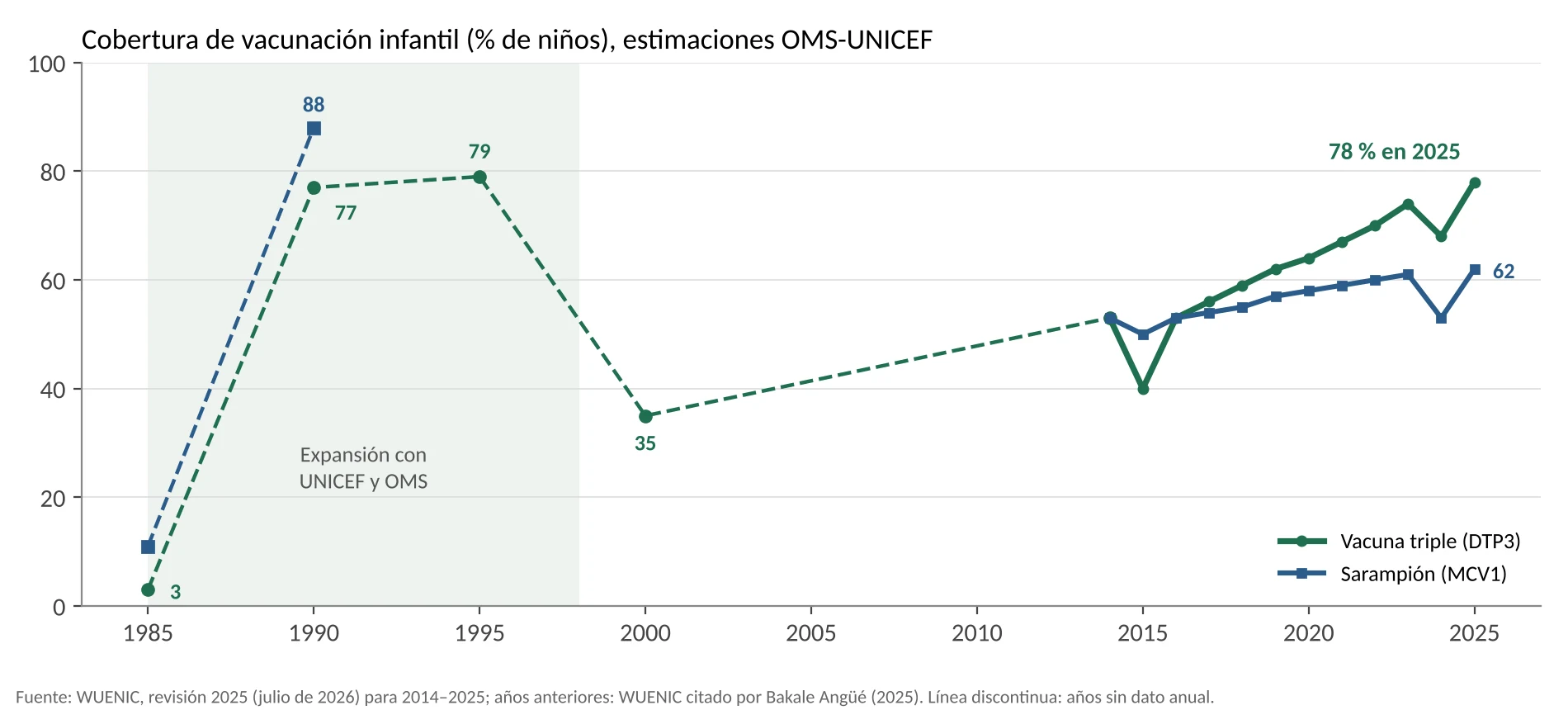
Childhood vaccination. With the support of UNICEF and WHO, immunisation went from minimal to reaching the great majority of children within five years. In 1985 only 3 % of children received the three doses of the DTP vaccine (DTP3) and 11 % the measles vaccine; by 1990 coverage was 77 % and 88 %, and it stayed around 80 % until 1998 (Bakale Angüé, 2025, with WHO and UNICEF data). In 1992 the country recorded its last indigenous case of wild poliovirus (GPEI).
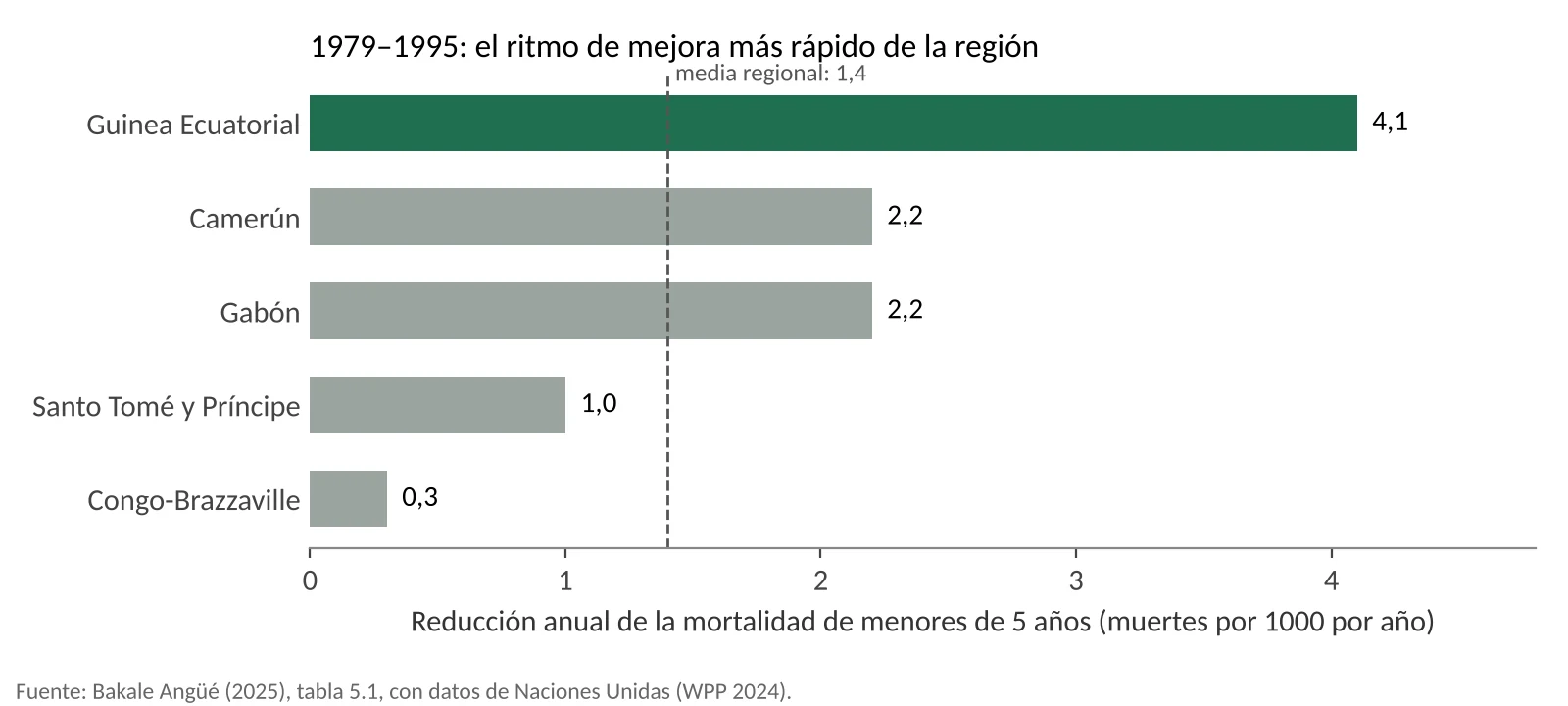
The results were among the fastest in the region. Between 1979 and 1995 under-five mortality fell from 235 to 170 per 1,000 and life expectancy rose from 43.0 to 51.9 years. The country reduced child mortality 2.8 times faster than the average of Cameroon, Gabon, Congo and São Tomé and Príncipe, and gained life expectancy 5.2 times faster (Bakale Angüé, 2025, with United Nations data).
In 1995 the National University of Equatorial Guinea (UNGE) was founded, making it possible for the first time to train health professionals in the country itself (Bakale Angüé, 2025).
51996–2015
Investment and modernisation
Oil and gas revenues made possible unprecedented investment in infrastructure: renovated regional and district hospitals, the La Paz Medical Centre and the arrival of cooperation medical brigades, such as the Cuban one. The La Paz Medical Centre opened in Bata in 2007 and in Sipopo (Malabo) in 2011 (EG Vistas, Embassy in Washington). Four new regional hospitals were also built, one of them opened in 2003 (Bakale Angüé, 2025). In 2013 the Government announced the renovation of every hospital in the country within four years (News-Medical).
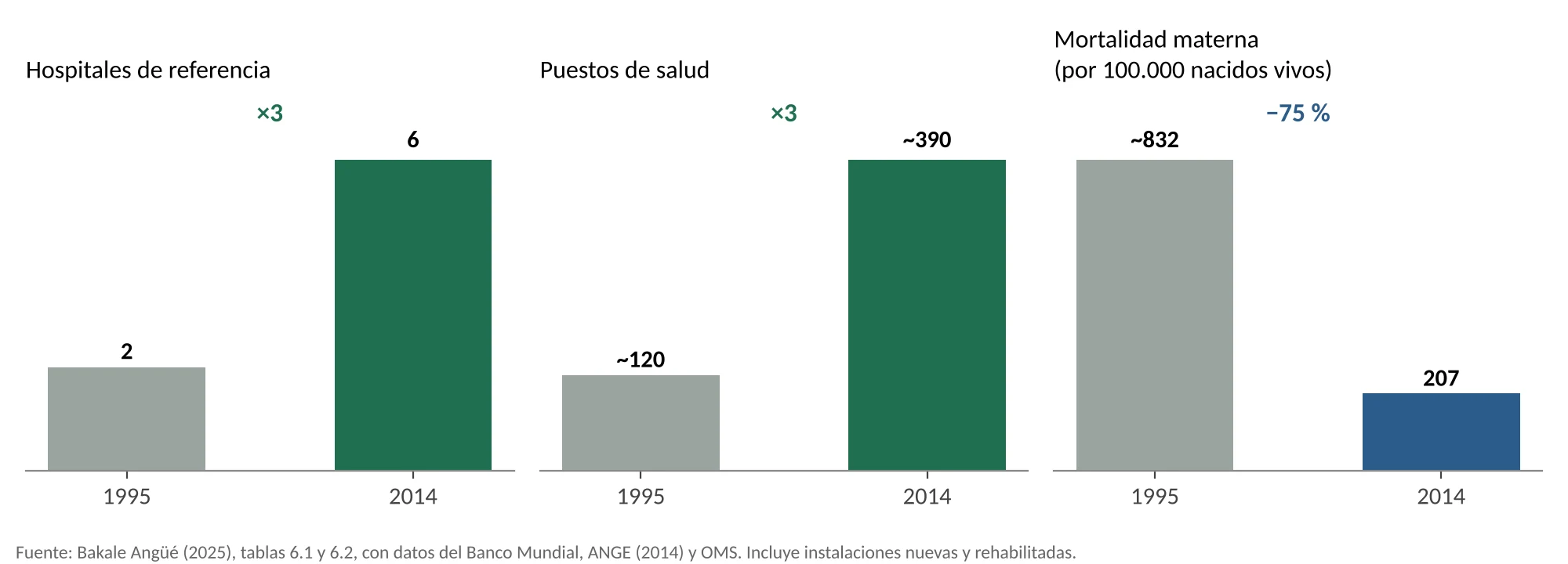
Between 1995 and 2014 the number of referral hospitals rose from two to six and health posts from about 120 to about 390, counting new and rehabilitated facilities (Bakale Angüé, 2025, with World Bank and ANGE data). The new network made it possible to extend assisted childbirth: maternal mortality fell from about 832 to 207 deaths per 100,000 live births, a 75 % drop that is among the fastest in sub-Saharan Africa in that period. Over the same years under-five mortality fell from 170 to 97 per 1,000 and life expectancy rose from 51.9 to 60.2 years (Bakale Angüé, 2025, with WHO and United Nations data).
The training of professionals took a leap forward. On 2 August 2000 the UNGE Faculty of Medical Sciences was created in Bata (Decree 83/2000); the medical degree began in the 2000–2001 academic year with some thirty students and Cuban teaching staff (Diplomatie, France).
Scientific cooperation also grew stronger. Since 2002 the Carlos III Health Institute has run the Reference Centre for Endemic Disease Control in the country (Country profile, OID). That same year a presidential decree approved the strategic framework for the fight against HIV/AIDS, with a National Council chaired by the Head of State (UN, 2006).
In February 2004 the Bioko Island Malaria Control Project (BIMCP) began, a public-private partnership between the Government, Marathon Oil and Medical Care Development International (Malaria Journal). Between 2004 and 2008 under-five mortality on Bioko fell from 155 to 52 per 1,000 births (Parasites & Vectors). Parasite prevalence in children aged 2 to 14 fell from 45 % in 2004 to 14 % in 2012 (AJTMH).
In 2010 Malabo hosted the 60th session of the WHO Regional Committee for Africa (WHO AFRO). The country also joined the Sanaria Inc. consortium for the development of the PfSPZ malaria vaccine (MINSABS).
Between July and November 2011 the Ministry carried out the first Demographic and Health Survey (EDSGE-I), covering about 5,000 households, which for the first time measured fertility, maternal and child health, malaria and HIV with a national sample (DHS Program). The survey estimated infant mortality at 65 per 1,000 (UPR report, UN) and HIV prevalence at 6.2 % among people aged 15 to 49 (DHS Program). The official 2014 evaluation of the PNDES recorded, for its part, a rise in life expectancy from 43.3 years in 2003 to 52 in 2011 (Bakale Angüé, 2025, with ANGE data).
In 2014, faced with a polio outbreak that affected eight children between January and May, the Ministry organised national vaccination campaigns that stopped transmission; the independent assessment of June 2015 confirmed it, and that year the inactivated polio vaccine was introduced (GPEI). That same year the country brought in 50 Cuban doctors for Ebola prevention during the 2015 Africa Cup of Nations (14ymedio).
62016–today
Strengthening the system
The current stage focuses on organising the system by health districts, improving the quality of care and securing its financing. Its roadmap is the National Health Development Plan (PNDS) 2021–2025, the first in the country's history.
The network built in the previous stage has sustained the improvement of the indicators even with fewer resources. Between 2014 and 2024 under-five mortality fell from 97 to 68 per 1,000, life expectancy reached 63.7 years (2023) and DTP3 coverage rose from 53 % in 2014 to 78 % in 2025, its best figure since the 1990s (Bakale Angüé, 2025, with United Nations and UN IGME data; vaccination: WUENIC, 2025 revision).
Childhood vaccination coverage, 2014–2025 (% of children). The annual series of WHO and UNICEF estimates shows steady progress in DTP3 and the introduction in 2021 of the second measles dose.
| Year | BCG | DTP3 | Measles, 1st dose (MCV1) | Measles, 2nd dose (MCV2) |
|---|---|---|---|---|
| 2014 | 85 | 53 | 53 | — |
| 2015 | 77 | 40 | 50 | — |
| 2016 | 85 | 53 | 53 | — |
| 2017 | 86 | 56 | 54 | — |
| 2018 | 86 | 59 | 55 | — |
| 2019 | 87 | 62 | 57 | — |
| 2020 | 87 | 64 | 58 | — |
| 2021 | 88 | 67 | 59 | 17 |
| 2022 | 88 | 70 | 60 | 13 |
| 2023 | 85 | 74 | 61 | 28 |
| 2024 | 77 | 68 | 53 | 31 |
| 2025 | 76 | 78 | 62 | 53 |
Research
On 28 October 2016 the Equatorial Guinea Malaria Vaccine Initiative (EGMVI) opened a clinical research centre in Baney for trials of the PfSPZ vaccine (MCD). In 2019 the Baney Research Laboratory came into operation (GHS Index), certified by WHO in March 2020 for COVID-19 diagnosis (MINSABS).
Health districts
In 2019 the Ministry completed a situation analysis of the National Health System and drew up district health plans for Baney, Kogo, Acurenam, Aconibe, Nsok-Nzomo and Annobón (MINSABS). On 2 November 2020 the Ministry launched the operationalisation of health districts in Baney, the first phase of their extension to the whole country. On 3 March 2022 Baney became the model district of the National Health Development Plan (PNDS) (MINSABS).
COVID-19
A national response and surveillance committee met daily from 16 January 2020 (Hommes d’Afrique). The first case was confirmed on 14 March 2020 and on 31 March Decree 42/2020 declared a state of health emergency (United Nations). In 2020 a Cuban Henry Reeve medical brigade of 76 specialists arrived (Guerrillero). Vaccination began in February 2021 with 100,000 doses donated by China (EFE/ABC), and that year the country led Africa in vaccinations per inhabitant (MINSABS).
Polio
On 25 August 2020 the WHO African Region, of which Equatorial Guinea is part, was certified free of wild poliovirus (GPEI).
Marburg
On 13 February 2023 the Ministry declared the country's first outbreak of Marburg virus disease, in the Continental Region. With 17 confirmed cases and 1,451 contacts traced, the outbreak was declared over on 8 June 2023, after 42 days without new cases (WHO; MINSABS).
Malaria
In 2019 the Bioko programme became the Bioko Island Malaria Elimination Project (BIMEP) (MCD). In September 2025, at the UN General Assembly, the International Coalition for the Elimination of Malaria in Equatorial Guinea was signed, with a 2030 target.
Infrastructure
Since 2024 the Ministry has also been responsible for health infrastructure, with the Urgent Improvement Plan for the public hospitals of Malabo and Bata. On 9 May 2024, with WHO support, the first public plant producing medical oxygen opened at Bata Regional Hospital (WHO).
Planning and financing
In 2021 the country launched the National Health Development Plan 2021–2025, the first in its history. After evaluating it, the Ministry is drawing up the second PNDS (2026–2030) and promoting Compulsory Universal Health Insurance (SMUOGE).
Health information
In 2022 the Eugenio Nkogo Data Processing Laboratory came into operation.
Household data
The INEGE Second National Household Survey (ENH2, 2022-23) provides verified data on the use of services: the public hospital is the first place people go when they have a health problem (46.8 %) (Bakale Angüé, 2025).
Health in figures (1968–2024)
In just over half a century, under-five mortality has fallen by three quarters and life expectancy has gained almost 19 years. The table compares the main indicators at the start and end of each stage.
| Indicator | 1968 | 1979 | 1995 | 2014 | 2024 |
|---|---|---|---|---|---|
| Under-five mortality (per 1,000 live births) | 249 | 235 | 170 | 97 | 68 |
| Life expectancy at birth (years) | 44.9 | 43.0 | 51.9 | 60.2 | 63.7 (2023) |
| Maternal mortality (per 100,000 live births) | — | — | ~832 | 207 | — |
| Hospital beds | ~1,700 | — | — | — | — |
| Referral hospitals | 1 | — | 2 | 6 | — |
| Health posts | — | — | ~120 | ~390 | — |
| DTP3 vaccine coverage (%) | — | 3 (1985) | ~79 | 53 | 78 (2025) |
| Measles vaccine coverage (%) | — | 11 (1985) | 88 (1990) | 53 | 62 (2025) |
| Adult literacy (%) | 20–25 (c. 1950) | — | ~74 | ~92 | 90.1 (2022-23) |
—: no reliable data. The 1968 referral hospital is Santa Isabel. Sources: Bakale Angüé (2025), based on the United Nations (World Population Prospects 2024), UN IGME (2025), WHO (GHO), WHO-UNICEF (WUENIC, 2024 and 2025 revisions), ANGE (2014) and INEGE (ENH2 2022-23); 1968 beds: Ligero Morote (UAM). Hospital and health post figures include new and rehabilitated facilities.
Pace of improvement by stage. Every stage has sustained the fall in child mortality and the rise in life expectancy.
| Stage | Annual reduction in under-five mortality (per 1,000) | Annual gain in life expectancy (years) |
|---|---|---|
| Reconstruction (1979–1995) | 4.1 | 0.56 |
| Investment and modernisation (1995–2014) | 3.8 | 0.44 |
| Strengthening (2014–2024) | 2.9 | 0.39 |
Source: Bakale Angüé (2025), tables 5.2, 6.2 and 7.2, with United Nations data.
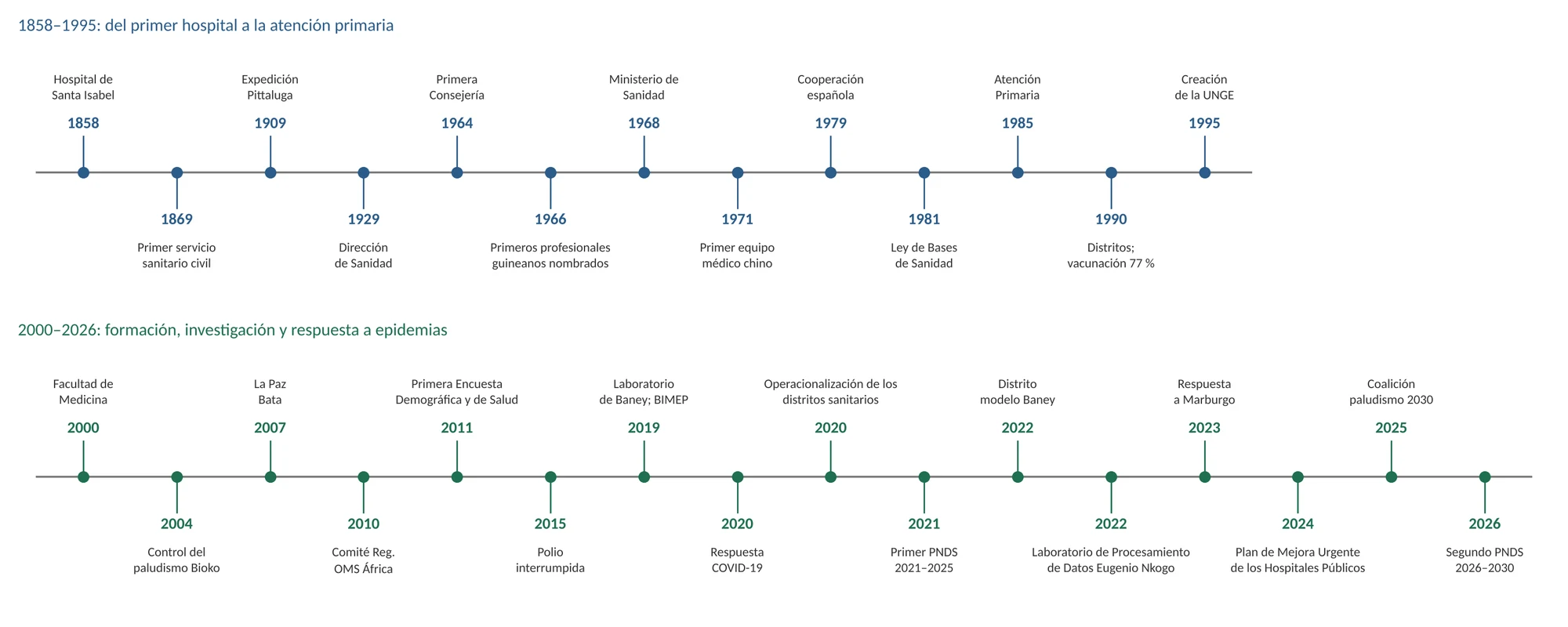
Detailed timeline (1778–2026)
1778
Treaty of El Pardo: start of the Spanish presence on Fernando Póo and Annobón
1827
The United Kingdom establishes Port Clarence (today's Malabo) on Fernando Póo
1843
Expedition of Juan José de Lerena: the Spanish presence is consolidated
1858
Santa Isabel Hospital opens (19 December), the territory's first hospital, and the colony's first Organic Statute
1859
Military Health section: two medical assistants, a pharmacist, two practitioners and a dispensary
1862–1864
Response to the yellow fever (1862) and smallpox (1864) epidemics, with vaccination; Santa Cecilia convalescent station in Basilé (1863)
1869
First civilian health service
1893
Luis López Saccone's thesis on malaria on Fernando Póo
1909
National Institute of Hygiene expedition on sleeping sickness, led by Gustavo Pittaluga and promoted by Ramón y Cajal
1927
Santa Isabel hypnosery for the treatment of sleeping sickness
1929
The Health Directorate and its laboratory are inaugurated (14 September)
1940–1950
The Mikomeseng leprosarium and the Ebebiyín camp centralise the fight against leprosy
1959
Provinces: Fernando Póo and Río Muni
1962
Frida Ayana Krohnert Esono, qualified practitioner of the Health Service
1963
Two Guinean doctors and five practitioners; a network of at least 13 hospitals
1964
Autonomous government; first Council for Health and Welfare, under Gustavo Watson Bueco; Elías Manuel Maho Sicacha, doctor of the Health Service
1965
Construction of the new Ebebiyín hospital
1966
Appointments of Damián Roku-Epitie, the midwives Mariana Dougan and María Luisa Gorbeña and the health technicians Victorina Koka and Deogracias Pearse; the Santa Isabel Nursing School trains Guinean nurses
1967
Public health investment reaches 76 million pesetas
1968
Independence (12 October) and creation of the Ministry of Health; some 1,700 beds and about 40 doctors
1971
The first Chinese medical team arrives (Canton), the start of an unbroken cooperation
1979
Spanish Technical Cooperation in health begins; Pablo Obama Eyang, Health commissioner of the Supreme Military Council
1980
Treaty of Friendship and Cooperation with Spain (23 October)
1981
Decree-Law 3/1981 on the Bases of Health: National Health Council, National School of Health and Central Public Health Laboratory
1983
With the Supreme Military Council dissolved, the Commissariat becomes the Ministry of Health
1985
Law 4/1985 on the National Traditional Medicine Service; Primary Health Care becomes the pillar of the sector
1990
District health management structures; DTP3 reaches 77 % of children and measles vaccine 88 %
1992
Last indigenous case of wild poliovirus
1995
Founding of the National University of Equatorial Guinea (UNGE)
1998
The portfolio is renamed Health and Social Welfare
2000
Creation of the UNGE Faculty of Medical Sciences in Bata (Decree 83/2000)
2002
Reference Centre for Endemic Disease Control (ISCIII); strategic framework for the fight against HIV/AIDS
2003
Opening of one of the four new regional hospitals
2004
Bioko Island Malaria Control Project (BIMCP)
2007
La Paz Medical Centre opens in Bata
2010
Malabo hosts the 60th session of the WHO Regional Committee for Africa
2011
La Paz Medical Centre in Sipopo (Malabo); first Demographic and Health Survey (EDSGE-I)
2012
Malaria prevalence in Bioko children falls to 14 %
2013
Plan to renovate every hospital in the country
2014
Response to the polio outbreak; cooperation doctors for Ebola prevention
2015
Interruption of polio transmission confirmed; inactivated vaccine introduced
2016
Baney clinical research centre for the PfSPZ vaccine; 28th Chinese medical team
2019
Baney Research Laboratory; BIMEP; situation analysis of the system and district plans
2020
Launch of the operationalisation of health districts (2 November, Baney); national COVID-19 response committee; first case (14 March); Henry Reeve medical brigade; Africa free of wild polio
2021
The country's first National Health Development Plan (PNDS 2021–2025); COVID-19 vaccination begins, with the country leading Africa per inhabitant
2022
Baney, model health district of the PNDS (3 March); Eugenio Nkogo Data Processing Laboratory
2023
Response to the first Marburg outbreak (13 February – 8 June)
2024
The Ministry takes on health infrastructure; Urgent Hospital Improvement Plan; first public medical oxygen plant (Bata)
2025
International Coalition for the Elimination of Malaria, signed at the UN General Assembly; DTP3 reaches 78 % of children
2026
Drafting of the second PNDS (2026–2030)
Heads of Health (1964–present)
The gallery brings together twenty-four terms of office held by twenty-two people: the Health councillor of the autonomous Government, the Health commissioners of the Supreme Military Council and the ministers of the Republic. The 1979–2023 cabinet series cover almost the whole period; the office holders for 1971–1976, 1978–1979 and 1990–1991 have yet to be identified. Each row is a card in the web gallery.
The portfolio has changed its name over time: Health Commissariat (1979–1982), Ministry of Health (1983–1993), Health and Environment (1994–1996), Health (1996–1998), Health and Social Welfare (1998–2024) and Health and Health Infrastructure (since 2024).
1964 – 1968
Gustavo de la Concepción Watson Bueco
Councillor for Health and Welfare (autonomous Government)
First Guinean head of health; member of the delegation to the 1967–1968 Constitutional Conference
1968 – c. 1969
Pedro Ekong Andeme
Minister of Health
First Minister of Health of the Republic; a native of Bata
1969 – 1971 and 1976 – 1978
Rafael Obiang Nsogo
Minister of Health
Held the portfolio for two periods; also Minister of Justice and of Industry and Mines
1971 – 1976 and 1978 – 1979
Office holders to be identified
Ministry of Health
Period before the available series; to be completed from the Ministry's archive
1979 – 1981
Pablo Obama Eyang
Health Commissioner (Supreme Military Council)
Member of the Supreme Military Council; head of Health in the first cabinet of 23 August 1979. Listed in the series as Pablo Nsue Obama Nyang
1981 – 1982
Nicolás Ondo Efua
Health Commissioner (Supreme Military Council)
Last office holder of the Supreme Military Council period
1982 – c. 1984
Emiliano Buale Borikó
Minister of Health
First Minister of Health after the dissolution of the Supreme Military Council (1983); previously Agriculture commissioner
c. 1984 – 1985
Policarpo Monsuy Mba
Minister of Health
Previously Justice commissioner and Minister of Water, Forests and Reforestation
1986 – 1989
Cristino Seriche Bioko Malabo
Prime Minister and head of Health
Took on the Health portfolio together with the leadership of the Government
1989
Sisinio Mbana Nsoro
Minister of Health
Later ambassador to several countries
1990 – 1991
Office holder to be identified
Ministry of Health
The series record no head of Health in these years
1992 – 1993
Anselmo Nsue Eworo
Minister of Health
1994 – 1996
Bernabé Ngore
Minister of Health and Environment
The only period in which the portfolio included the Environment
1996 – 1998
Darío Tadeo Ndong Olomo
Minister of Health
1998 – 1999
Salomón Nguema Owono
Minister of State for Health and Social Welfare
First term; since 1998 the portfolio has included Social Welfare
1999 – 2001
Juan Antonio Bibang Ntutumu
Minister of Health and Social Welfare
Later Minister of Youth and Sports
2001 – 2003
Marcelino Nguema Onguene
Minister of Health and Social Welfare
Previously Minister of State for Foreign Affairs and for the Economy
2003 – 2006
Justino Obama Nve
Minister of Health and Social Welfare
Addressed the UN General Assembly on HIV/AIDS in June 2006
2006 – 2008
Antonio Martín Ndong Ntutumu
Minister of Health and Social Welfare
2008 – 2011
Francisco Pascual Obama Asue
Minister of Health and Social Welfare (Minister of State from 2010)
Chaired the 60th session of the WHO Regional Committee (Malabo, 2010); later Prime Minister (2016–2023)
May 2012 – 2013
Tomás Mecheba Fernández Galilea
Minister of Health and Social Welfare
Doctor; delegate minister for Health in 2003 and 2011; announced the plan to renovate every hospital in the country
2013 – 2014
Diosdado Vicente Nsue Milang
Minister of Health and Social Welfare
Surgeon and orthopaedist; 24 years at WHO. Delegate minister for Health in 2012
2014 – 2016
Juan Ndong Nguema
Minister of Health and Social Welfare
Led the 2014–2015 response to the polio outbreak
2016 – 2020
Salomón Nguema Owono
Minister of State for Health and Social Welfare
Second term; announced the first COVID-19 case (14 March 2020). President of the Chamber of Deputies in 1999–2008 and since 2024
2020 – 2023
Diosdado Vicente Nsue Milang
Minister of Health and Social Welfare
Second term; led the national COVID-19 response and the launch of the health district
2023 – present Current
Mitoha Ondo’o Ayekaba
Minister of Health and Social Welfare; since 2024, Health and Health Infrastructure
Economist; deputy minister from 2018 to 2023; confirmed by Decree 60/2026 of 23 June
Sources for the list of office holders: Equatorial Guinea’s Cabinet Dataset (1994–2020), by Ana Lúcia Sá and Edalina Sanches (ISCTE), and the 1979–2023 cabinet series of Equatorial Guinea compiled from the Europa World Year Book, WhoGov and official data; appointment decrees for 1968–1979 and 2024–2026.
Delegate ministers and deputy ministers for Health (1998–2023)
| Year | Name | Position |
|---|---|---|
| 1998 | Pilar Buepoyo Boseka | Delegate Minister for Health and Social Welfare |
| 2003 | Tomás Mecheba Fernández Galilea | Delegate Minister for Health and Social Welfare |
| 2004 | Pedro Abaga Esono | Deputy Minister for Health |
| 2008 | María Vida Asue Ndong | Deputy Minister for Health and Social Welfare |
| 2011 | Tomás Mecheba Fernández Galilea | Delegate Minister for Health |
| 2012 | Diosdado Vicente Nsue Milang | Delegate Minister for Health and Social Welfare |
| 2012 | Miguel Obiang Abeso | Deputy Minister for Health and Social Welfare |
| 2013 | Miguel Obiang Abeso | Delegate Minister for Health and Social Welfare |
| 2013 | Víctor Sima Oyana | Deputy Minister for Health and Social Welfare |
| 2018 – 2023 | Mitoha Ondo’o Ayekaba | Deputy Minister for Health and Social Welfare |
Source: Sá and Sanches, Equatorial Guinea’s Cabinet Dataset (1994–2020), available appointment years; 2018–2023, appointment decrees.
Sources
This account draws on 63 references: official records (BOE, decrees), academic studies, international organisations (WHO, UNICEF, United Nations) and the press. They are grouped by subject and in alphabetical order; links open the original source in a new tab.
History of health care 1827–1968 and pioneers11
- Alogo Oyana, M. M. (2024). La evolución del sistema sanitario en Guinea Ecuatorial. Undergraduate dissertation, Rey Juan Carlos University.
- De Granda Orive, J. (2011). «Sanidad Militar y aspectos sanitarios en Fernando Poo durante el gobierno de los brigadieres (1859–1869)». Sanidad Militar, 67(1), 53–60
- Jones Sánchez, A. (2015). Marcos formales, recorridos informales. Doctoral thesis, University of Castilla-La Mancha
- López Saccone, L. (1893). Apuntes médico-geográficos sobre la isla de Fernando Póo y consideraciones acerca del paludismo como enfermedad predominante del país. Madrid.
- Nájera Morrondo, R. (2019). El Instituto de Salud Carlos III en el marco de la evolución de la Salud Pública. Instituto de Salud Carlos III.
- Nsé Angüe, A. G. (2022). «La gestión de la pandemia de COVID-19 en Guinea Ecuatorial». African Anthropologist, 21(1), 87–121
- Pélissier, R. (1964). Los territorios españoles de África.
- Pittaluga, G. Viaje de estudio a la Guinea española.
- Spanish Official Gazette (BOE): 28-09-1962 · 27-11-1964 · 11-07-1966 · 07-09-1966 · 28-09-1966 · 06-12-1966 · 04-01-1969
- United Nations (1967). A/6700/Add.6, para. 17
- Working paper «Historia de la sanidad en Guinea Ecuatorial (1827–1968)» and annex «Pioneros y pioneras de la sanidad ecuatoguineana», first draft (Ministry, November 2026).
History of the health system22
- 1966 debate at the United Nations (Reparación Africana)
- 1967–1968 Constitutional Conference
- Autonomy referendum of Equatorial Guinea
- Baney health district (MINSABS)
- BIMCP, Malaria Journal 2007 · Parasites & Vectors 2012 · AJTMH 2020
- BIMEP (MCD)
- Decree-Law 3/1981 on the Bases of Health (FAO-LEAP)
- EG Vistas: La Paz Medical Centres (Embassy in Washington)
- Estudios Africanos (UAM)
- Health indicators of Equatorial Guinea (ULL)
- Health sector laws and decrees (FAOLEX)
- Jones Sánchez, A. (2016), Revista de Antropología Social, UCM
- Law 191/1963 on the Bases of the autonomous regime (BOE)
- Law 4/1985 on the National Traditional Medicine Service (FAO-LEAP)
- Military Health on Fernando Poo
- Rafael Obiang Nsogo (Rulers.org)
- Report of the Spanish Technical Cooperation in Equatorial Guinea
- Social Policy Country Brief (University of Bremen)
- Spanish Guinea
- Statement by Justino Obama Nve at the UN, 2006
- The Pittaluga expedition, 1909 (Revista de Neurología)
- WHO AFRO, RC60 (2010) · Speech by F. P. Obama Asue
Other sources12
- Baney clinical research centre, 2016 (MCD) · Baney Research Laboratory (GHS Index) · WHO certification of the Baney laboratory (MINSABS)
- Brydan, D. (2018). Mikomeseng: Leprosy, Legitimacy and Francoist Repression in Spanish Guinea. Social History of Medicine
- Chinese medical teams in Equatorial Guinea since 1971 (AidData)
- Cuban doctors for Ebola prevention, 2014 (14ymedio)
- Demographic and Health Survey EDSGE-I 2011 (DHS Program) · HIV prevalence, EDSGE-I · Universal Periodic Review of Equatorial Guinea (UN)
- First public medical oxygen plant, Bata 2024 (WHO)
- Last wild polio case by country (GPEI) · Polio transmission stopped, 2015 (GPEI) · Regional certification (GPEI)
- Ligero Morote, A., «Epítome sobre una evolución sanitaria de la Guinea Ecuatorial durante la colonización (1778-1986)», Estudios Africanos (UAM)
- Marburg outbreak, 2023 (WHO) · Ministry epidemiological update, May 2023
- Operationalisation of the health district (MINSABS)
- Progress report on the COVID-19 response, March–July 2020 (United Nations) · Henry Reeve brigade (Guerrillero) · Arrival of the first vaccines (EFE/ABC)
- UNGE Faculty of Medical Sciences, Decree 83/2000 (French Ministry of Foreign Affairs)
Health indicators 1968–20241
- Bakale Angüé Oyana, E. (2025). La pregunta equivocada. Desarrollo, datos y distorsiones cognitivas en Guinea Ecuatorial, 1968-2024. Unpublished manuscript, unedited version. Its series come from the United Nations (World Population Prospects 2024), UN IGME (2025), WHO (Global Health Observatory), WHO-UNICEF (WUENIC 2025), the World Bank (2025), ANGE (2014 and 2019) and INEGE (ENH2 2022-23).
Vaccination1
Heads of Health14
- Amnesty International, 2007
- Appointment decree, 2024
- Country profile, Diplomatic Information Office
- COVID-19 SITREP report, October 2020
- Decree 60/2026 of 23 June (Real Equatorial Guinea)
- Decree on the new Government, June 2026 (Ahora EG)
- Equatorial Guinea’s Cabinet Dataset 1994–2020 (ISCTE)
- First Government of 1968 (CPDS)
- Francisco Pascual Obama Asue (VOA)
- Interview with Tomás Mecheba Fernández (Guinea Ecuatorial Press)
- Justino Obama Nve (OpenSanctions/Wikidata)
- MINSABS organisation chart
- Salomón Nguema Owono (OpenSanctions/Wikidata)
- Supreme Military Council of Equatorial Guinea
Cabinet series2
- Cabinet series of Equatorial Guinea 1979–2023, compiled from the Europa World Year Book, WhoGov and official data.
- Sá, A. L. and Sanches, E. Equatorial Guinea’s Cabinet Dataset (1994–2020), ISCTE–University Institute of Lisbon, Harvard Dataverse (ISCTE).
Text: Ministry of Health and Health Infrastructure, based on the sources cited.